

KEY CREATIVE WRITING SKILLS

Creating an effective structure (fiction)
This guide deals with how to plan a piece of fiction writing in an exam or other form of assessment. At SHSG, we only ask you to do this from Year 10 onwards — before that you’ll always plan your creative writing in lessons before you use the assessment time to write what you have planned.
Quick links
Two key principles for planning fiction
A plan is not the same as some notes or a brainstorm or any similar writing down of ideas. A plan is about structure — you are outlining the order in which you will write your piece:
What will you write first?
What will you write next?
What will you write after that?
And so on
In order for a set of ideas to become an actual plan, they must:
Be put in order (key principle 1)
Go from the start to the end (key principle 2) — for fiction writing this may be the end of the opening of a longer story, but there should still be some kind of end point, even if it’s not the final resolution of the story
That’s what a plan is. One way to think about this is to ask yourself what would happen if you gave someone else your ‘plan’ and asked them to write it up in full. How similar would their piece be to what you have in your head? If the plan is an actual plan, then their piece should be quite similar, at least in terms of overall content.
What a plan needs to include
In the next section of the guide we’ll go through what you need to include in a plan, including what type of structure you need to plan and what information should go into the plan itself.
1. Plan narrative structure not plot structure
The first thing you need to understand when planning fiction is the difference between plot structure and narrative structure.
Plot structure is the order in which the actual events of a story take place
Narrative structure is the order in which the writer tells the reader about the events in the story
These two structures may be very similar, but they are unlikely to be exactly the same, especially if the story is well structured. You need to plan your narrative structure, not your plot structure, with timeshifts signalled in your plan.
You will look at both of these things in much more detail in your GCSE English Language lessons.
2. Plan how to write, not just what happens
Your plan also needs to includes directions to you, the writer, in terms of what you need to do as you tell the story. You need to plan how you will tell your story, not just what happens in it. So, you might include things like “describe the café in detail” or “show don’t tell her reaction to the dinosaur” or “increase the tension here”. There are many ways you could plan these kind of directions to yourself, but some examples include:
Description (e.g. describe the man’s elegant hat)
Characterisation (e.g. convey Peter’s awkwardness and insecurity)
Direct speech (e.g. use indirect speech to convey conversation)
And so on
We’ll come back to this idea later in the guide when we talk about building blocks in the development section.
Planning a story (or a story opening)
In the next section of the guide we’ll go through the actual process of planning, step-by-step, with examples for each step. Depending on how creative you are and how confident a writer you are, some of these steps may be more difficult and time-consuming than others, but you’ll always follow this basic process, even if some of the steps take only a few seconds for you.
1. Coming up with an idea
Before you create the actual plan, you’re going to need an idea based on the question you’ve been asked. For the purposes of this guide we’ll use this GCSE question as our question:
Write the opening of a story about a game that goes badly wrong.
When you encounter a question like this in an exam, you’re going to need to think fast. You are likely to find yourself in one of the following situations:
You have a new idea right away — hooray!
You think of an old story idea that you can repurpose to fit this question, with a few edits — also hooray!
You draw a blank
If situations 1 or 2 occur then you’re probably good to move straight on to step 2 in our process. But if you find yourself in situation 3, then you’re going to need to do a bit of brainstorming to come up with some kind of an idea to work with before you start the actual planning. We would suggest you jot down your thoughts in a non-chronological way and develop your ideas from there. This might look like this:
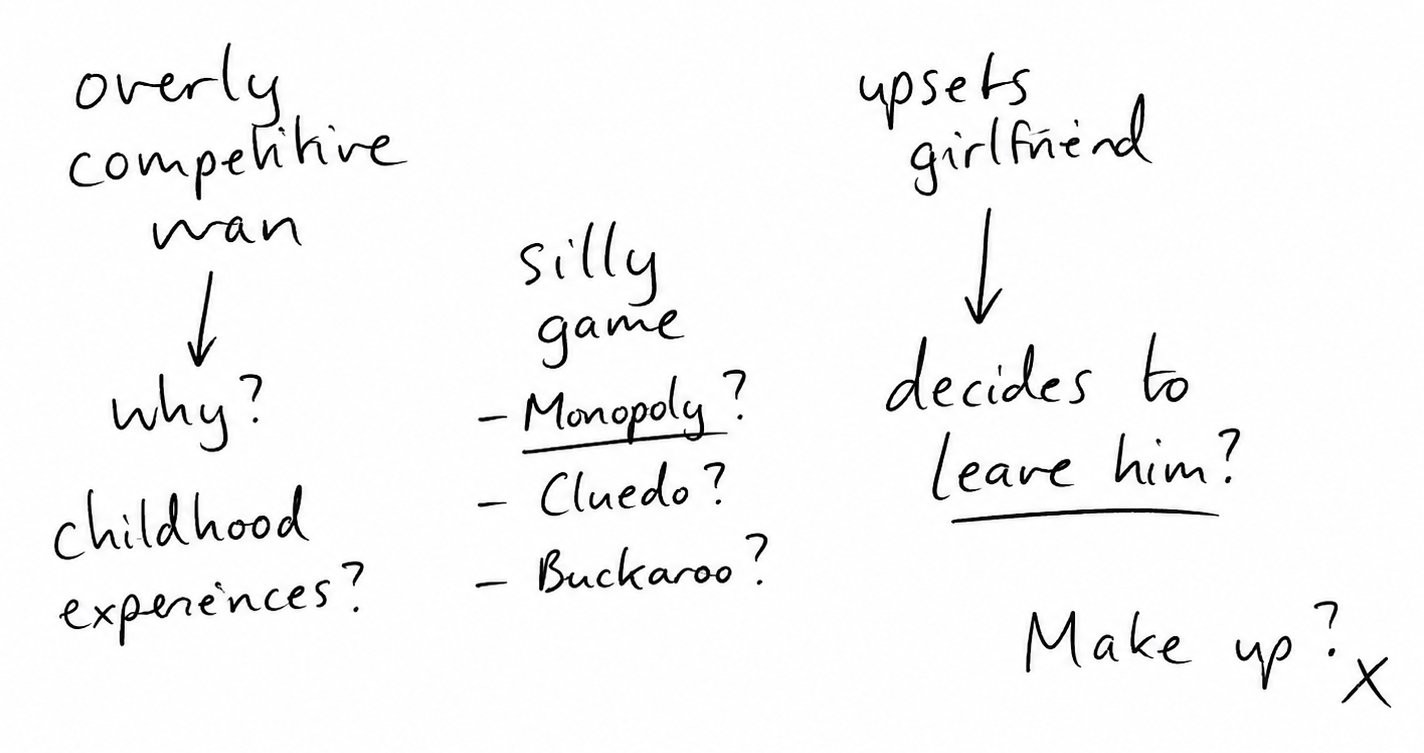
The thinking represented in this brainstorm roughly went as follows:
An overly competitive man ruins a game
Ruins it how? He upsets his girfriend
Why is he overly competitive? Some kind of childhood experience (can be figured out in the planning)
What game? Something silly — Monopoly decided on
What’s the consequence? She leaves him. (Ruled out making up as an ending)
Now we have an idea for a story in response to the question. We just need to plan it.
2. Deciding how to start
Once you’ve got your idea, you need to decide how you’re going to start your story/story opening. We’ll continue to use this GCSE question for our example in this guide:
Write the opening of a story about a game that goes badly wrong.
Because we are planning the narrative structure of our story and not the plot structure, we don’t have to start at the very beginning of the story timeline. This is crucial for effective story planning. Do not start before the events of your story get interesting.
The most common example of this (and the most irritating for teachers when we read students’ stories) is when a story starts with a character waking up in the morning. ARGH! This is a terrible way to start a short story. Get to the good stuff quickly — don’t bore your reader with breakfast!
Generally, you will start your stories in medias res (i.e. in the middle of things) to engage the reader from the off. You can then use brief timeshifts to fill them in on what’s happened earlier in your plot structure to help them understand what’s going on. (We explain how to do this in our guide to using timeshifts to create a non-linear structure.)
Let’s look at our story idea and think about where might be the best place to start a short story about an overly competitive man who upsets his girlfriend in a game of Monopoly. We have a lot of options from our plot structure:
Some time before the game of Monopoly begins
At the start of the game of Monopoly
At a point in the game when the man gets overly competitive and ruins it
At the end of the game when things have already gone wrong
When the man is trying to console his upset girlfriend
After his girlfriend has left him and he looks back on what’s happened
There is no correct answer to this, as such, since this story could theoretically be told from any of these starting points, but there are a few general principles we can apply because we’re writing this story in an exam, with limited time:
Where does the conflict in the story start? Your narrative structure should start very close to that, or after that in the timeline, since you don’t have long to write your story
Where are the most interesting thoughts and feelings for your characters in the story? You want to include those in your telling of the story, and you don’t want to run out of time before you get to them
What parts of the story are the easiest to write well in an exam situation
If we apply the first two principles then we can rule out 1 and 2 in our plot structure — we definitely need to start telling the story later than that.
Then we can think about the third principle: what’s easiest to write? Writing about a game with multiple characters, with all the dialogue that would be involved in that, and making this sound authentic, especially the argument between the overly competitive protagonist and his girlfriend, would be hard to write. A brilliant writer could definitely do it, but it's not easy. We wouldn’t want to try to do this in an exam. This rules out starting point 3 in our set of options.
That just leaves options 4-6. We are left starting at the end of the plot structure. This is generally how things will go. More often than not, this step in the planning process will involve you deciding to start your narrative structure near the end of your plot structure. That’s almost always a good decision.
But how near the end? We could start with option 4 (the end of the game), but that would mean having to write how the game goes wrong in some detail which might be tricky, or we could start with option 6 (after she’s left him), but that would mean we wouldn’t be able to include the most interesting thoughts and feelings of our protagonist, so we’re going to go for option 5 (when he’s trying to console her).
This is not necessarily the best place to start this story — it could certainly be written well from a different starting point — but we thought about the options and decided this was the one we felt most comfortable writing well. That’s what you’ll need to do with your story ideas in exams too — consider the options and pick the one that you’re most comfortable writing in a way that meets the assessment criteria.
You won’t think through the process as systematically as we have outlined it here because you won’t have time, but if you’ve practised this planning process enough times before the exam, then you should be able to go from the idea (step 1) to the starting point (step 2) in less than a minute of thinking. You’ll apply the sort of logic we’ve outlined here, but you’ll do it instinctively: you’ll just know that that is a bad place to start and that is a good place.
3. Starting your actual plan
Once you’ve decided how you are going to start, you’re ready to begin your plan. This is easy. You should just decide what’s going to go in your opening paragraph or so.
At this point you will also start to think about what components of story writing you will include (description, characterisation, direct speech, etc). We’ll talk more about this in the next part of the guide, but for this first example we’ve used the code DS to represent ‘direct speech’ — we would include the words in this first bullet point as direct speech near the start of our story.
Sally is crying in the bedroom — DS: “Go away”
This works nicely as a story opening because, for the reader, we have a bit of mystery. What’s happened? Why is she so upset?
With the first bullet point of the plan written, you’re ready to plan the rest of your story.
4. Planning the rest — purposeful planning
Now that you have your idea (i.e. the overall shape of your story) and your starting point, you are ready to plan the rest of it.
Content types from which to construct a story
We would suggest you plan your story using different types of story content as building blocks. This will help you to plan purposefully to meet the assessment criteria for the exam (see below) and also help ensure your story has some content variety. It’s important to say that these content types are not paragraphs types — you may combine two or more content types in a single paragraph (e.g. characterisation and setting description), or split one content type over several paragraphs (e.g. direct speech) — but you can still think of them as bricks from which you construct your plan.
These content types all draw on the fiction writing guides on the website.
Characterisation — where you develop the reader’s understanding of your character through thought and action (see our guide to creating character)
Setting description — where you situate the reader in the place of your story, and use the setting to create mood, atmosphere and even symbolic meaning (see our guide to describing settings)
Direct speech — where you bring your characters to life through their words (see our guide to direct speech)
Timeshifts — where you provide exposition for your plot and further characterisation (see our guide to timeshifts)
Fast-time storytelling — where you move the plot forward through action, or provide condensed exposition e.g. through timeshifts (see our guide to controlling time in a story)
Slow-time storytelling — where you create tension or provide detailed characterisation and description (see our guide to controlling time in a story)
As you can see from just these bullet points, these content types are intimately connected. Direct speech can be used for characterisation; timeshifts usually involve fast-time storytelling; description of setting is slow-time storytelling; and so on. That’s why these aren’t paragraph types — they’re a toolkit that you can use to construct your story.
Using the content types to create a plan
To help you understand how this works, we’ll talk you through how we used the content types to construct our plan. We won’t go through the whole plan, but we’ll describe the thinking behind the first half of it. You can see the thinking on the left and the plan on the right:
Thinking
We start with some action (Sally crying, the direct speech) so we need to situate the reader by describing the setting — we can use this setting description introduce the Monopoly game and also introduce our protagonist (Peter) with some characterisation through his thoughts about the setting [bullet point 2]
We can add some more mystery and intrigue to the story by implying the friends left in a hurry through more show don’t tell description [bullet point 3]
Now it’s time to reveal the mystery and catch up the reader up with a timeshift, providing some exposition [bullet point 4]
Now we need to come back to the present timeline — but how…? Some more characterisation would be good to help develop the idea of Peter as an overly competitive man — let’s humanise him by making him self-aware and ashamed [bullet point 5]
Now we can explain why he’s like that - let’s include another timeshift, this time back to his childhood [bullet point 6]
And so on…
All we’ve done here is illustrate what might be going on in your head as you’re writing your plan. We’re thinking through the story here in terms of what kind of content would be good at each stage, and then we turn that into the plan on the right. This is the kind of thing you’ll do as you turn your story idea into a story plan.
Planning
Sally is crying in the bedroom — DS: “Go away
Peter starts putting Monopoly away — describe living room — P’s regret, shame
Describe other friends’ stuff they left behind – show don’t tell they left in a hurry
Timeshift — summarise monopoly game — Peter so competitive — humiliated Sally — stormed off
P’s thoughts — why does he always do this?
Timeshift — remembers childhood monopoly games — brother always won — humiliated him
Planning purposefully
The other important thing you need to think about as you plan is how you are going to meet the assessment objectives. This includes where you’re going to include ambitious vocabulary, where you’re going to include varied and complex sentences, where you’re going to show a solid grasp of grammar and paragraphing, where you’re going to vary your punctuation, and so on. We discuss these things in more detail in our GSCE-specific guide to AO6, but this should be at the back of your mind as you plan:
Setting description is good for long sentences and vocabulary
Characterisation, especially thought, is good for vocabulary and short sentences
Timeshifts are good for grammar (providing you get the tense right)
Direct speech is good for paragraphing and punctuation (providing you get the punctuation right)
To complete our plan we would continue to think through the content types purposefully, in the manner illustrated above, thinking about how we plan to meet the assessment objectives, and that would produce the following full story plan.
Full story plan
Sally is crying in the bedroom — DS: “Go away”
Peter starts putting Monopoly away — describe living room — P’s regret, shame
Describe other friends’ stuff they left behind – show don’t tell they left in a hurry
Timeshift — summarise monopoly game — Peter so competitive — humiliated Sally — stormed off
P’s thoughts — why does he always do this?
Timeshift — remembers childhood monopoly games — brother always won — humiliated him
Knocks on bedroom door — direct speech: tentative, apologises
Opens bedroom door — Sally is packing her things
Indirect speech – she's had enough – not just this game — its everything: “Call me when you get over your issues” — leaves flat
Peter finishes putting monopoly stuff away — circular structure
Planning a whole story vs. planning an opening
As of June 2026, the AQA GCSE exam requires you to write “the opening of a story” rather than a whole story (as it used to before 2026). What does that mean in terms of the planning process?
Well, at the moment we’re not totally sure as, at time of writing, only one cohort of students has sat this exam and we don’t even have the results for that cohort yet, nor the chief examiners report for 2026.
However, right now, it seems to us that the most logical thing to do is to use your planning time to plan the amount of the story that you can write in the time. Generally, you’ll have an ideas for a whole story (like in our example above) and then you’ll plan the start of that story. By the time you get to GCSE you will have practised this enough to have some idea of what you can plan and write in 45 minutes. Then, if you run out of time and don’t get to the end of your plan, it’s not the end of the world — you’ve just written less of your opening than you intended to. Hopefully, it won’t affect your mark too much.
As such, if we take our example from earlier in this guide, a plan for the opening of that story to be written in a GCSE exam might look like this:
A plan for the opening of our story
Sally is crying in the bedroom — DS: “Go away”
Peter starts putting Monopoly away — describe living room — P’s regret, shame
Describe other friends’ stuff they left behind – show don’t tell they left in a hurry
Timeshift — summarise monopoly game — Peter so competitive — humiliated Sally — stormed off
P’s thoughts — why does he always do this?
Timeshift — remembers childhood monopoly games — brother always won — humiliated him
Knocks on bedroom door — direct speech: tentative, apologises
You should be able to see that this is identical to the main example plan, except it finishes about 3 bullet points earlier. This is probably a reasonable amount to write in 45 minutes and still allows you to meet the assessment objectives for the story, even though it’s not finished yet.
Planning the opening of a BIG story
The other possibility that this new question wording opens up is writing a much bigger story than the example we include here. Let’s say that when you come up with your idea, instead of focussing on a small story of an overly competitive man, instead you come up with the idea for a dystopian epic about a totalitarian dictatorship that forces different districts to send children as tributes to fight to the death in some kind of arena. That sounds like a pretty good idea for a story.
Could you write the opening of a story like that in your GCSE exam?
The short answer is yes. It’s probably best if you don’t just rip off a hugely successful series of novels that have been adapted into hugely successful series of films, as this kind of plagiarism will lose you marks, but if you want to aim big and write the opening of a fantasy epic or a ghost story or an adventure story about pirates, the new GCSE wording does give you that option, which you didn’t really have before.
Should you write the opening of a story like that in your GCSE exam, though?
Well, that depends on how good a writer you are.
If you’re a good enough writer, then by all means aim big and have some fun. But if you struggle with creative writing, then it’s probably easier to plan a smaller story (like the example in this guide) as those kinds of stories are easier to write than The Hunger Games or Lord of the Rings or The Shining.
Summing up — key things to remember when planning fiction
A plan conveys the structure of the piece: it must be in order and it must go from the start to the end, even if the end is the end of the opening of your fiction piece
When planning fiction, you need to plan the narrative structure of your piece (how you will tell the story, including directions to yourself on what to write) and not the plot structure (the order in which things happen)
You need to come up with an idea first
Then you need to decide how you will start — this should be in as interesting a place in the narrative structure as you can manage
Then you should start your actual plan, including purposefully planning varied content for your story that will help you to meet the assessment criteria
Planning a story opening means planning however much of the story you can write in the time you have available in the exam
It’s okay to plan the opening of a big story, like a novel, though this is generally harder than planning a small story, so only do it if you’re a confident writer