

KEY CREATIVE WRITING SKILLS

Creating an effective structure (non-fiction)
This guide deals with how to plan when writing non-fiction writing at GCSE (and in Year 9 at SHSG). It is not a guide for how to write effective non-fiction. It’s just about how to plan, which is, in itself, both important and challenging. There are other guides which deal with how to actually write non-fiction pieces.
Quick links
Why planning is essential
Planning is essential for non-fiction writing. You must must have something you want to say before you start writing. And you need some sense of the structure of this. You need to have something engaging at the start, and you need to develop your ideas across your piece. You also need to bring your piece to some kind of satisfying resolution, ideally one which links back to your opening. This requires planning. It’s impossible to do this well without planning. This guide will take you through what it means to write a plan (and also what doesn’t count as a plan), before giving you some tips on how to plan non-fiction pieces.
Two key principles for planning
A plan is not the same as some notes or a brainstorm or any similar writing down of ideas. A plan is about structure — you are outlining the order in which you will write your piece:
What will you write first?
What will you write next?
What will you write after that?
And so on, until you get to the end.
In order for a set of ideas to become an actual plan, they must:
Be put in order (key principle 1)
Go from the start to the end (key principle 2).
That’s what a plan is. One way to think about this is to ask yourself what would happen if you gave someone else your ‘plan’ and asked them to write it up in full. How similar would their piece be to what you have in your head? If the plan is an actual plan, then their piece should be quite similar, at least in terms of overall content.
However, for non-fiction writing especially, you need to something else first, before you start the actual plan: you need some ideas.
Brainstorming ideas
With non-fiction writing you’ll be given a statement that you may never have even thought about before (e.g. “Holidays don’t need to be faraway and expensive. They just need to give people a break from everyday life and the chance to relax.”) and you will need to write a whole piece arguing your opinion of this statement.
This is going to require some thought.
As such, the first stage of the planning process for this task should be an unstructured brainstorm in which you write down all the things that come to mind when you think about the issue raised in the statement, in whatever order they come to mind.
You may not write about all these things in your final piece, but you should write them down first before you decide.
Give yourself at least 5 minutes to do this. Think for a bit; then write down what comes to mind; then think a bit more, and write what comes to mind. And so on… This might include writing down:
Different opinions you have (for or against the statement)
Episodes from your own life that are relevant to the statement
Things from the real world that are relevant to the statement (facts you happen to know, relevant parts of pop-culture, things from the news, stuff that has happened to people you know, etc)
Literally anything else that comes to mind — just write everything you think of down
In this unstructured brainstorm phase you should just jot these things down with a word or short phrase as soon as you think of them. We suggest doing this in a non-linear form (e.g. not a bullet point list) just to help you separate it from the much more linear planning phase, but it doesn’t really matter how you do it — whatever feels more natural to you. There’s an example of the kind of thing we mean below for the statement about holidays.
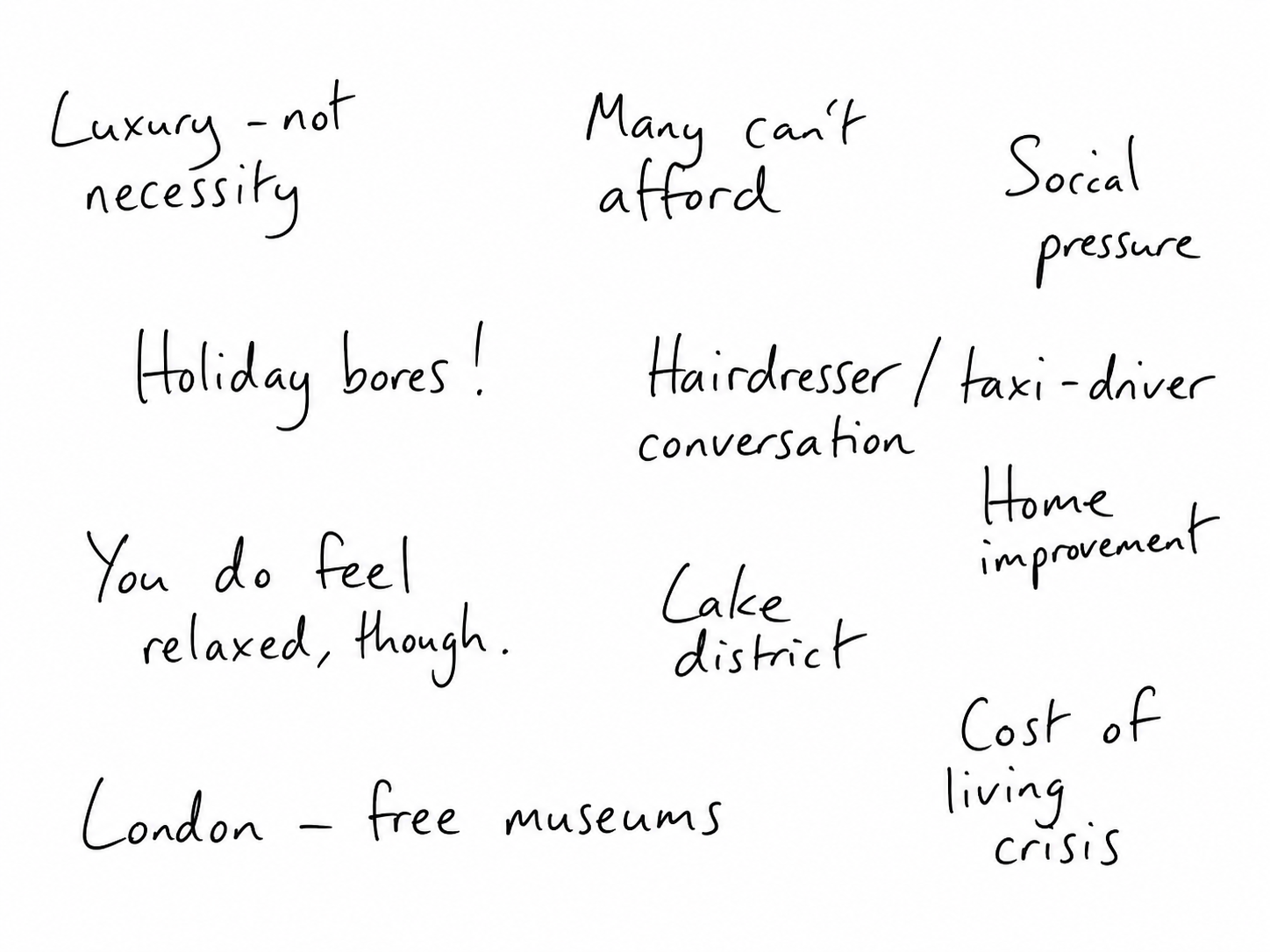
As you can see, this is very far from a plan for an article. However, there are ideas here that could be shaped into an article.
With the initial brainstorm complete, the next step is to look at all of these ideas and think about how they might be linked together to create your final piece:
What ideas are connected?
What ideas are outliers that might be best forgetting about in your final piece for time reasons?
What ideas (if any) are just bad and should be ignored?
It is very likely that some and perhaps several ideas won’t make their way into your final plan. That’s how it should be.
As you decide all of this, you should draw some lines (and probably write some numbers) to mark what ideas you want to include and in what order. This final part of the brainstorming process might look something like this:
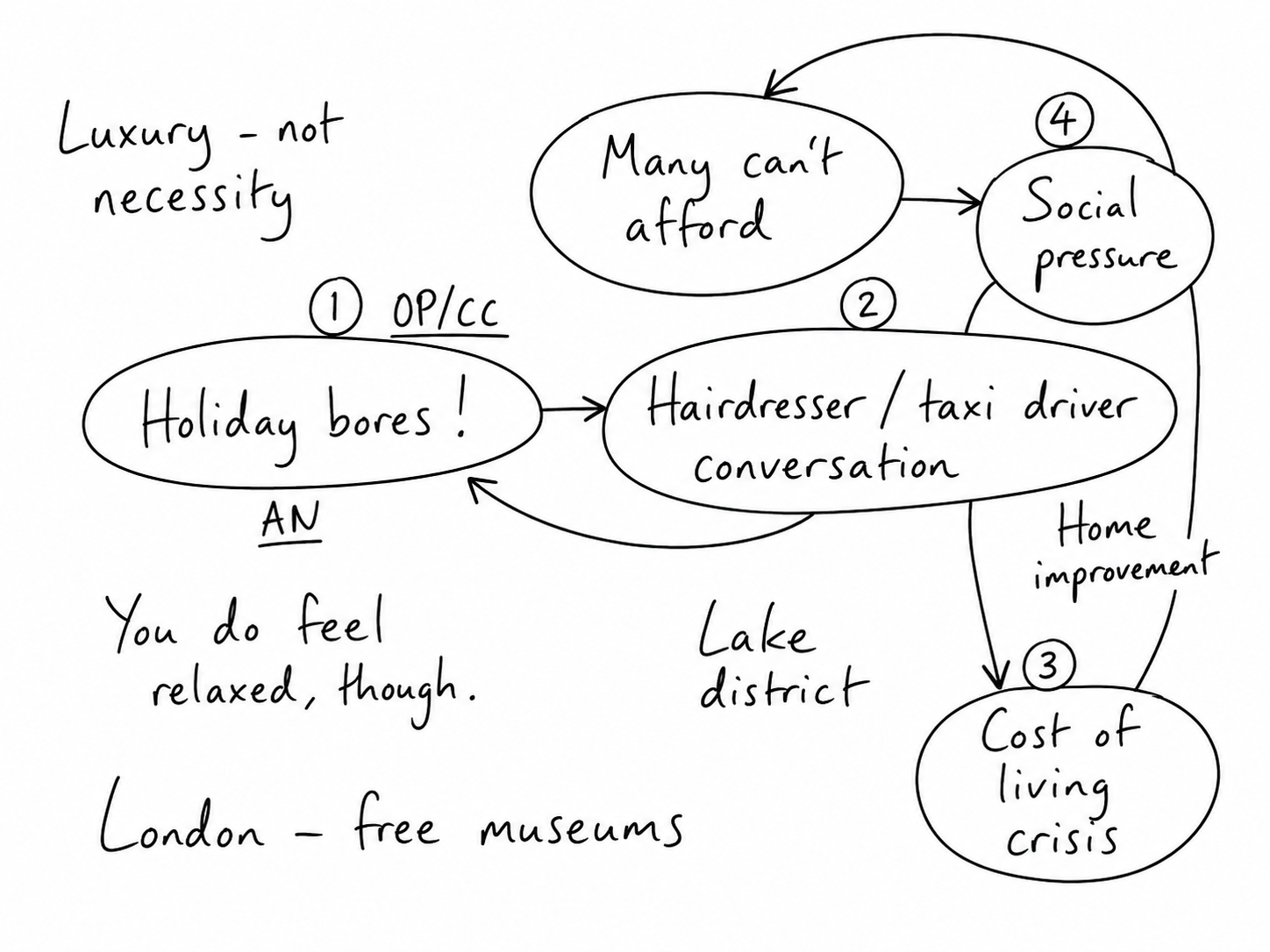
This does not have to be exactly what you write in your article — you can change your mind in the next planning stage, and also when you are writing your piece if you have a new and better idea — but it will give you something to work with while you plan and write your piece.
Writing your actual plan
Once you’ve got your ideas sorted — and the rough order you want to add them in — you need to create the actual plan for your piece. This will basically be in two steps, that you might have decided in the second part of your brainstorm:
How are you going to open/close your piece?
What will your argument be in the body of your piece?
The opening/closing
The first thing you will need to decide for most types of non-fiction is the opening and matched closing. You should be aiming to create a circular structure, where the end of the piece links back to the start in some way to bring about a satisfying ending. There are two separate guides on the website for how to write openings/closings — you should look at part 1 first, obviously.
The body
You will then need to plan the basic contents of each paragraph in the body of your piece — one bullet point per paragraph. For exam pieces you need at least 3 and as many as 5 paragraphs between your opening and closing; you won’t have time to write more than this.
Remember that you will be making an argument in your non-fiction writing, so your paragraphs should build on one another; this is something you will think about as you write your plan.
When planning the body of your piece you should also write the type of paragraph you are going to write. Roughly speaking, it will be one of the following three types:
Argument paragraphs — where you explain your view of something and the reasons you hold it (could be abbreviated to ARG in your plan)
Anecdote paragraphs — where you tell a story about your own life (could be abbreviated to AN in your plan)
Real world evidence paragraphs — where you talk about something in the real world which illustrates your point, either something from the news or something from popular culture, like a meme or a TV advert or film or something similar (could be abbreviated to RW in your plan)
You can also combine paragraph types in a single paragraph (e.g. RW/ARG or AN/ARG).
You will generally have a mixture of all three of these paragraph types in any piece of non-fiction writing. You don’t have to include them all, but it can help to think in these terms as you plan to give you some varied content. There is a separate guide on how to write these different types of paragraph.
If we take the brainstorm example from earlier, this might become the following full plan, using the codes suggested above: AN = anecdote paragraph, ARG = argument paragraph, RW = real world evidence paragraph:
A non-fiction plan with the opening/closing and the body clearly set out
Opening — AN about holiday bores — they’re the worst
ARG/AN — holidays are given too much importance in society — adverts, small talk (where did you go? says hairdresser and taxi-driver), etc
RW — cost of living crisis - inflation, fuel, etc — lots of people struggling
ARG — unfair social pressure - better to spend money on essentials, on making the day to day better (e.g. home improvement)
Closing — AN about how to deal with holiday bores — cut them off: “Boring!” — “I didn’t go on holiday” — make them uncomfortable — take the moral high ground
This is a solid plan. It takes the ideas from the brainstorm and arranges them clearly into a series of paragraphs which would come together to form a piece of non-fiction writing (an article or a speech, most likely).
Each bullet point is a separate paragraph, and there is a clear idea for how to open the piece in an engaging way, with a matched closing at the end.
The types of paragraph are also included in the plan using the abbreviations mentioned earlier in the guide (ARG, AN and RW).
There is a lot that still needs to be decided in order to actually write the piece, but that’s perfectly fine: you’re only writing a plan at this stage. The rest will come out in the actual writing.
Planning is not an optional extra — you must plan every piece of writing you produce
A plan conveys the structure of the piece: it must be in order and it must go from the start to the end
Before you start to plan you need some ideas — you should give yourself at least 5 minutes to think and brainstorm
You should then turn the brainstorm into a proper plan
When you plan you should think carefully about how you will create a circular structure, with an opening and matched closing
You should use one bullet point per paragraph, ideally including the type (or types) of paragraph you will write for that paragraph — it’s perfectly okay to blend multiple paragraph types into one